In the contemporary global scenario, the working of the complex and multidimensional factors on the time behaviour of financial series necessitates an investigation of the underlying characteristic features of the same. In addition to the state of the art econometric approaches, analysis in terms of state space dynamics considering the financial time series as deterministic chaos has emerged to be of utmost importance. Understanding the dynamics of a financial series, as a stock market index or a commodity market index is still however, a complex task having its specific requirements. Market behaviour, in case of both commodity and securities is ultimately reflected by the average trading price movement . Thus the time series representing the indices in the respective markets is a key to understanding the economic similarities/dissimilarities in the two markets. Our purpose was to analyse the time series representing the indices of commodity and stock markets .
Friday, May 21, 2010


Friday, May 14, 2010
Global classical solutions of the Boltzmann equation with long-range interactions
This is a brief announcement of our recent proof of global existence and rapid decay to equilibrium of classical solutions to the Boltzmann equation without any angular cutoff, that is, for long-range interactions. We consider perturbations of the Maxwellian equilibrium states and include the physical cross-sections arising from an inverse-power intermolecular potential r -(p-1)
with p > 2, and more generally. We present here a mathematical framework for unique global in time solutions for all of these potentials. We consider it remarkable that this equation, derived by Boltzmann in 1872 and Maxwell in 1867, grants a basic example where a range of geometric fractional derivatives occur in a physical model of the natural world . Our methods provide a new understanding of the effects due to grazing collisions.
http://www.pnas.org/content/107/13/5744.abstract?sid=9d675b61-b4d1-4bc0-88d1-b450d0b4b5ca
Philip T. Gressman and Robert M. Strain
University of Pennsylvania, Department of Mathematics, Philadelphia, PA 19104-6395
Tuesday, May 11, 2010
Time travel? Maybe
Einstein and Rosen made a very bold supposition: What if a traveler fell into the mouth of something that looked like a black hole, but rather than being crushed by a singularity at the center of a black hole, instead emerged from another mouth, potentially many light-years from where he or she started ?. This isn't as crazy as it sounds. Einstein's theory of general relativity -- our current working model for how gravity and space work -- has been confirmed with countless experiments. And, as ad hoc as it sounds, an Einstein-Rosen bridge is a perfectly valid solution to the equations of general relativity.
Graphene transistor could advance nanodevices
 For years, scientists and researchers have been looking into the properties of carbon nanotubes and graphene for use in nanoelectronics.
 There is no real mass application of devices based on graphene and carbon nanotubes, Zhenxing Wang tells PhysOrg.com.
This is really an opportunity for them to show their capabilities.
Death of a star in 3D
.jpeg) (
( PhysOrg.com ) -- Researchers at the Max Planck Institute for Astrophysics in Garching have for the first time managed to reproduce the asymmetries and fast-moving iron clumps of observed supernovae by complex computer simulations in all three dimensions. To this end they successfully followed the outburst in their models consistently from milliseconds after the onset of the blast to the demise of the star several hours later. ( Astrophysical Journal, May 10th, 2010 ).
Friday, April 23, 2010
Unraveling the physics of DNA's double helix
The stability of DNA is so fundamental to life that it's important to understand all factors, said Piotr Marszalek, a professor of mechanical engineering and materials sciences at Duke.
If you want to create accurate models of DNA to study its interaction with proteins or drugs, for example, you need to understand the basic physics of the molecule . For that, you need solid measurements of the forces that stabilize DNA.
DNA construction kit for nanoengines
.jpg)
For a rotaxane molecule consists essentially of an axle and a ring, or hoop, threaded over it. To prevent the hoop from slipping off the axle, bulky
stoppersare placed at each end. These, in turn, consist of intertwined rings. The whole construction looks rather like a dumbbell with a hoop around its handle ( see diagram ).
Sunday, April 18, 2010
Laser technology provides a quantum leap (La tecnología láser da un salto cuántico)

En la Universidad de Innsbruck ( Austria ), un equipo de investigación financiado con fondos comunitarios ha creado un láser de átomo único que se rige por el mismo principio que los láseres clásicos pero que además presenta propiedades cuánticas en sus interacciones entre átomos y fotones. Los resultados de su investigación, publicados en la revista Nature Physics, ampliarán el conocimiento que se posee de las propiedades de los láseres y podrán utilizarse para medir composiciones de oligoelementos gaseosos e isótopos de carbono en el aire y el suelo.
At the University of Innsbruck ( Austria ), a team of private funded research has created a single atom laser which is governed by the same principle as lasers but also presents classical quantum properties in interactions between atoms and photons. The results of their research, published in the journal Nature Physics, expand the knowledge of the lasers properties and may be used to measure gas compositions of trace elements and isotopes of carbon in the air and soil.
Tuesday, April 6, 2010
La mayor tormenta solar en 500 días inquieta a los científicos

Una vez más, y esta vez con más fuerza y de forma totalmente inesperada, el Sol ha dado muestras de que ha despertado de su letargo. El telescopio espacial 'Tesis' registró el lunes la mayor tormenta geomagnética desde octubre de 2008, según informa el Instituto ruso de Física 'Lebedev'. La tormenta solar alcanzó el nivel 7 en una escala de 10, el máximo histórico del último año y medio. Su fase activa se prolongó de las 10.00 a las 19.00 horas. "No se han producido fluctuaciones de tal magnitud durante 540 días, desde el 11 de octubre de 2008", aseguran los técnicos. Una gran actividad solar no presagia nada bueno en un mundo absolutamente dependiente de la tecnología.
Once again, this time harder and quite unexpectedly, the Sun has shown that he has awakened from its slumber. The Hubble Space 'thesis' posted on Monday, the largest geomagnetic storm of October 2008, according to the Russian Institute of Physics 'Lebedev'. The solar storm reached level 7 on a scale of 10, the record high last year and a half. Active phase lasted from 10.00 to 19.00. "There have been no fluctuations of such magnitude for 540 days, from October 11, 2008", say the technicians. A high solar activity does not bode well in a world utterly dependent on technology.
Saturday, April 3, 2010
Viajar a la velocidad de la luz mataría en pocos segundos

Malas noticias para todos los que soñábamos con recorrer la galaxia a velocidades relativísticas. Según parece, al desplazarnos a velocidades cercanas a la de la luz, los escasos átomos de hidrógeno que existen en el espacio
vacíonos golpearían tan duro como las partículas aceleradas por el Gran Colisionador de Hadrones ( LHC ). Si los científicos de la Universidad Johns Hopkins están en lo cierto, esos pequeños átomos nos freirían en pocos segundos .
Bad news for all those who dreamed of exploring the galaxy at relativistic speeds. Apparently, the motion at speeds approaching that of light, the few hydrogen atoms that exist in the
vacuumwould hit us as hard as particles accelerated by the Large Hadron Collider ( LHC ). If scientists at Johns Hopkins University are right, these little atoms will fry us in a few seconds .
Charging Ahead: Carbon Nanotubes Could Hold Long-Sought Battery Technology Breakthrough
 With battery technology advances long overdue, researchers are racing to develop more efficient ways to store power. One hopeful option is in the use of carbon nanotubes, which can store much more electricity by weight than lithium-ion batteries while keeping their charge and remain durable for far longer .
Thursday, March 25, 2010
Fossil finger points to new human species
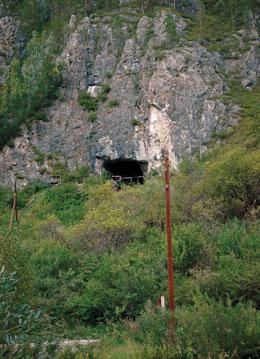
Its genetic material told another story. When German researchers extracted and sequenced DNA from the fossil, they found that it did not match that of Neanderthals — or of modern humans, which were also living nearby at the time.
Tuesday, March 23, 2010
The Bose-Einstein Condensate
ATOMIC TRAP cools by means of two different mechanisms

First, six laser beams ( red ) cool atoms, initially at room temperature, while corralling them toward the center of an evacuated glass box.
Next, the laser beams are turned off, and the magnetic coils ( copper ) are energized. Current flowing through the coils generates a magnetic field that further confines most of the atoms while allowing the energetic ones to escape. Thus, the average energy of the remaining atoms decreases, making the sample colder and even more closely confined to the center of the trap.
Ultimately, many of the atoms attain the lowest possible energy state allowed by quantum mechanics and become a single entity known as a Bose-Einstein condensate.
Monday, March 22, 2010
Light Improvement: Could Quantum Dots Boost the Quality of Cell Phone Pix?

Semiconductor crystals known as quantum dots have long held the promise of improving solar cells, lasers and lighting fixtures, but the reality is that integrating these fluorescent nanoparticles into existing technologies has proved difficult. One Silicon Valley start-up now aims to change this by the end of next year using quantum dots to vastly improve the picture-taking quality of cell phone cameras.
Sunday, March 21, 2010
Scientists supersize quantum mechanics

A team of scientists has succeeded in putting an object large enough to be visible to the naked eye into a mixed quantum state of moving and not moving.
Saturday, March 20, 2010
Scanner scans a 200 page book in one minute (w/ Video)

A research team led by Professor Masatoshi Ishikawa of the University of Tokyo has developed a prototype scanner that allows users to scan a book simply by rapidly flipping its pages. A high-speed camera operating at 500 fps and producing pictures with a resolution of 1280 x 1024 pixels, takes pictures of the page and its contents of text and images under ordinary light. A laser then projects lines on the page, and the camera captures this image as well. The lines allow the system to adjust for the curvature and distortion of pages as they are being flipped, and the software reconstructs the image into a digitized picture of a flat, regular page.
Friday, March 19, 2010
Perelman wins Millenium Prize for proving Poincaré conjecture


The American Clay Mathematics Institute has awarded the Russian maths genius Grigori Perelman a million dollars for proving what is known as the Poincare Conjecture, a milestone theorem which opens up a whole new field in geometry. The Institute says such breakthroughs happen once in a millennium and cannot be allowed to pass unrewarded. Forty-six-year-old Mr. Perelman meantime is a known recluse who has already rejected a gold medal and cash from the latest World Mathematical Congress for his remarkable discovery. He has spent the period since 2006 in a remote suburban location without contact with colleagues. His former superior at the Steklov Mathematical Institute Professor Sergei Kislyakov warns the Clay Institute that Dr. Perelman is likely to ignore his latest international honour.
Thursday, March 18, 2010
A Theory Set in Stone: An Asteroid Killed the Dinosaurs, After All

Although any T. Rex–enthralled kid will tell you that a gigantic asteroid wiped the dinosaurs off the planet, scientists have always regarded this impact theory as a hypothesis subject to revision based on further evidence gathered from around the globe. Other possible causes, such as volcanism and smaller, multiple asteroid strikes, never actually went away,
and over the years researchers raised important points that did not fully jibe with a history-changing celestial impact near the Yucatan peninsula one awful day some 65.5 million years ago.
Thursday, March 11, 2010
A New Spin on Conductivity: Electric Signals Can Propagate through an Insulator: Scientific American

But that is precisely what a group of Japanese researchers has found, as detailed in a study in the March 11 issue of Nature. The electric current induces a collective excitation in the magnetic insulator that can travel relatively long distances before unloading its momentum to generate a voltage when it reaches an electric conductor.
Subscribe to:
Posts (Atom)