Showing posts with label Casimir Effect. Show all posts

Friday, August 21, 2009

Escuela Franco-Venezolana de Nanotecnología 2009 ( ENANO2009 ) del 2 al 6 de noviembre de 2009 en Caracas y Choroní, Venezuela

Contacto

http://www.redvnano.org/congreso/contactanos.html

La Red Venezolana de Nanotecnología está ayudando a organizar la Escuela Franco-Venezolana de Nanotecnología 2009 ( ENANO2009 ) del 2 al 6 de noviembre de 2009 en Caracas y Choroní ( Venezuela ), bajo el patrocinio de:
  • FONACIT
  • Programa de Cooperación de Postgraduados ( PCP )
  • Embajada de Francia en Caracas
  • Fundación IDEA
  • Academia de Ciencias Físicas, Matemáticas y Naturales
  • Universidad Central de Venezuela

Para el primer día del evento ( 2/11/09 ) se ha programado una jornada en la Fundación IDEA ( Caracas, Venezuela ) en la cual varios investigadores presentarán los desarrollos obtenidos fruto de la cooperación franco-venezolana en nanociencia y nanotecnología, gracias al apoyo de las herramientas de cooperación científica entre estos dos países.

El Comité Organizador de la ENANO2009 también ha programado sesiones de cursos, charlas y carteles del 3 al 6 de noviembre de 2009. Esta segunda parte de la Escuela tendrá lugar en Choroní, Edo. Aragua. Las sesiones van dirigidas a estudiantes e investigadores sensibles al desarrollo de estos conocimientos en Venezuela.

Se programarán además mesas de trabajo sobre aspectos asociados al programa de doctorado interinstitucional de nanotecnología que la Red se encuentra promoviendo, la cooperación nacional e internacional en actividades de I+D+i dirigidas a atender los problemas de interés nacional, la definición de mecanismos que faciliten la comunicación entre el sector científico, productivo y la sociedad en general.

Formalismo de Keldysh (Keldysh Technique)

This technique provides the correct evaluation of the quantum mechanical average of an observable. It means that there is not any assumption about the final system state whenever we perform the above mentioned average. As a consequence, it is a suitable tool to study small systems in contact with macroscopic systems which are in "different" thermodynamic equilibrium states.

See the original Keldysh's papers:

  • L. V. Keldysh, ZhEFT 47, 1515 (1964)
  • L. V. Keldysh, Soviet Physics JEPT 20, 1018 (1965)

Friday, April 24, 2009

The Casimir Effect and Nanomachines

Johannes Diderik van der Waals
The Casimir effect can be viewed as a manifestation of the quantum mechanical zero-point energy of the vacuum, and has recently been hyped as if it were something new and mysterious that will assist or maybe ruin advanced nanomechanical systems. It has inflamed the minds of something-for-nothing energy enthusiasts, too.

Friday, March 13, 2009

Air QERV Technology Explained (Casimir effect)

Wikipedia: In physics, the Casimir effect and the Casimir-Polder force are physical forces arising from a quantized field. The typical example is of two uncharged metallic plates in a vacuum, placed a few micrometers apart, without any external electromagnetic field.

Relativistic Hydrogen molecules extract energy from Vacuum Flucuations (pre-paper)

The claims of sub zero states of hydrogen have been controversial for years and caused the study of this field to languish for what may prove to be nothing more than semantics. A 2005 paper by Jan Naudts paper (5 August 2005). "On the hydrino state of the relativistic hydrogen atom" [5] contends that the sub zero state argument overlooks relativistic effect inside Casimir cavities. Relativistic hydrogen implies a temporal axis solution where the hydrino orbital remains stationary relative to a moving boundary as the atom rotates away from our plane reshaping the 4D boundary. The Casimir cavity enlarges the temporal axis so the atom and its boundaries relax “upward” on the temporal axis while reducing its profile in our plane. The orbital gets no closer to the nucleus from a 4D perspective where the nucleus is further displaced from the orbital on the temporal axis.

Saturday, March 7, 2009

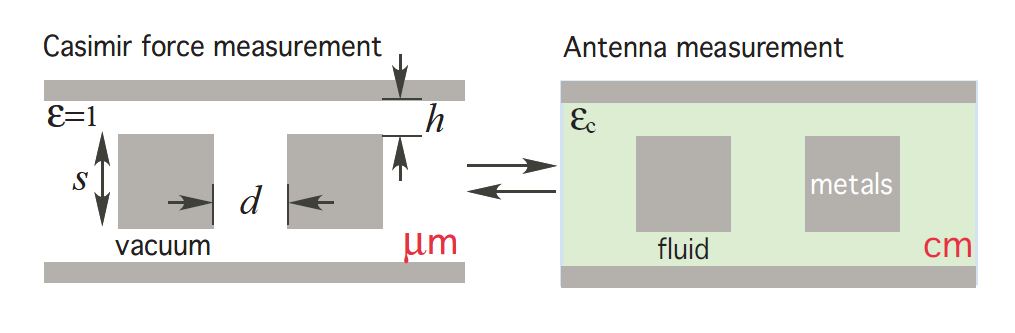
Centimetre scale models could compute Casimir forces

The Casimir force is notoriously difficult to measure. So tricky is it, that the first accurate measurements weren’t made until 1997 and even today only a handful of labs around the world of capable of taking its measure. Of course there are various ways of modelling what goes on theoretically but even the most powerful simulations these struggle to cope with simple shapes let alone complex geometries. Consequently, our knowledge of the Casimir force and how to exploit it is poor.

Now Alejandro W. Rodriguez and pals at MIT are suggesting a rather entertaining third way: to calculate Casimir forces using scale models that work like analogue computers.

References Alejandro W. Rodriguez, Alexander P. McCauley, John D. Joannopoulos, Steven G. Johnson. Ingredients of a Casimir analog computer.
http://arxiv.org/abs/0903.0599