Showing posts with label sociophysics. Show all posts

Saturday, September 25, 2010

Understanding behavioural patterns: why bird flocks move in unison

Animal flocks, be it honeybees, fish, ants or birds, often move in surprising synchronicity and seemingly make unanimous decisions at a moment’s notice, a phenomenon which has remained puzzling to many researchers.

New research published today in the New Journal of Physics ( co-owned by the Institute of Physics and German Physical Society ), uses a particle model to explain the collective decision making process of flocks of birds landing on foraging flights.

Using a simple self-propelled particle (SPP) system, which sees the birds represented by particles with such parameters as position and velocity, the researchers from Budapest, Hungary, find that the collective switching from the flying to the landing state overrides the individual landing intentions of each bird.

Monday, June 7, 2010

Physicsts reveal how to cope with 'frustration'

For most people, frustration is a condition to be avoided. But for scientists studying certain "frustrated" ensembles of interacting components -that is, those which cannot settle into a state that minimizes each interaction-

 it may be the key to understanding a host of puzzling phenomena that affect systems from neural networks and social structures to protein folding and magnetism.

Friday, May 21, 2010

Recurrence Analysis of Stock and Commodity indices

In the contemporary global scenario, the working of the complex and multidimensional factors on the time behaviour of financial series necessitates an investigation of the underlying characteristic features of the same. In addition to the state of the art econometric approaches, analysis in terms of state space dynamics considering the financial time series as deterministic chaos has emerged to be of utmost importance. Understanding the dynamics of a financial series, as a stock market index or a commodity market index is still however, a complex task having its specific requirements.  Market behaviour, in case of both commodity and securities is ultimately reflected by the average trading price movement . Thus the time series representing the indices in the respective markets is a key to understanding the economic similarities/dissimilarities in the two markets.  Our purpose was to analyse the time series representing the indices of commodity and stock markets .

Friday, October 30, 2009

EconoPhysics (On offer: laws of nature)

In yesterday's post I asked why economics doesn't have a few laws of nature that could prevent people from basing decisions on the financial equivalent of a perpetual motion machine. Enter the econophysicists, academics, ( usually physicists delving outside the field and not economists borrowing from physics ), who want to apply the rigorous mathematical methods of physics to understanding the economy. By modeling the economy as a collection of minor actors, like the molecules of gas, they hope to uncover how individual actions give rise to the emergent, large-scale phenomena that have sweeping effects—the booms and busts that take us by surprise.

Tuesday, October 20, 2009

Stephen Wolfram: The Man Who Cracked The Code to Everything ...

..."The climax of the book is the principle of computational equivalence, which may as well be called "Wolfram's law." After hundreds of pages of laying groundwork, presenting case after case of visual examples where simple rules generate counterintuitively complex results, Wolfram concludes that this phenomenon is overwhelmingly commonplace - it's at the base of everything from morphology to traffic jams. Then he goes further, stating that once a system achieves a certain, easily attainable degree of complexity, it's reached the point of maximum complexity, as measured by the computation required to crank out the end result. Everything at that level of complexity - and that means almost everything you can think of, from human thought to rain hitting pavement - is exactly as complex as anything else."...

Friday, September 25, 2009

Pedagogía by Andrés Ibáñez

Pedagogía. Enseñar a enseñar. La falacia dice que  no sólo es necesario saber de algo, sino que también es necesario saber enseñarlo . Este principio o axioma casi místico se basa, como el amable lector habrá visto enseguida, en una presuposición no menos axial y mística, y no menos falaz que la anterior: A saber, que todos aquellos que no son pedagogos, no son ni pueden ser nunca buenos profesores.

Monday, August 31, 2009

AAAI Fall Symposium - Nov. 5 - 7, 2009 - Arlington, VA

Complex Adaptive Systems and the Threshold Effect: Views from the Natural and Social Sciences

Most interesting phenomena in natural and social systems include constant transitions and oscillations among their various phases. Wars, companies, societies, markets, and humans rarely stay in a stable, predictable state for long. Randomness, power laws, and human behavior ensure that the future is both unknown and challenging. How do events unfold ? When do they take hold ? Why do some initial events cause an avalanche while others do not ? What characterizes these events ? What are the thresholds that differentiate a sea change from a non-event ?

Complex Adaptive Systems have proven to be a powerful tool for exploring these and other related phenomena. We characterize a general CAS model as having a large number of self-similar agents that:

  1. utilize one or more levels of feedback;
  2. exhibit emergent properties and self-organization; and
  3. produce non-linear dynamic behavior.

Advances in modeling and computing technology have led not only to a deeper understanding of complex systems in many areas, but they have also raised the possibility that similar fundamental principles may be at work across these systems, even though the underlying principles may manifest themselves differently.

Thursday, July 2, 2009

Mark Gimein -> Swan Song: Why Nassim Taleb is Still Wrong

While for just about everyone involved in the markets the last two years of financial history have been a massacre, they have been a long victory lap for Nassim Nicholas Taleb. Taleb is the author of The Black Swan, the book about, as the subtitle puts it, "The Impact of the Highly Improbable." It came out in 2007, just before everything that seemed highly improbable became painfully actual. As everyone else's fortunes have shrunk, Taleb's have risen. Not only have his books made him the public face of the New Catastrophism, but his insights have turned out to be extremely profitable: The Wall Street Journal reports that Universa, a hedge fund for which Taleb serves as guru and adviser, gained more than 100 percent last year and now holds $6 billion.

Ant mega-colony takes over world

A single mega-colony of ants has colonised much of the world, scientists have discovered. Argentine ants living in vast numbers across Europe, the US and Japan belong to the same inter-related colony, and will refuse to fight one another. The colony may be the largest of its type ever known for any insect species, and could rival humans in the scale of its world domination. What's more, people are unwittingly helping the mega-colony stick together. Argentine ants (Linepithema humile) were once native to South America. But people have unintentionally introduced the ants to all continents except Antarctica. These introduced Argentine ants are renowned for forming large colonies, and for becoming a significant pest, attacking native animals and crops.

Mancur Olson (La Lógica de la Acción Colectiva, etc...)

Mancur Olson ( 1932 - 19 de febrero de 1998 ) fue un destacado economista y sociólogo estadounidense que, en el momento de su muerte, trabajaba en el College Park de la Universidad de Maryland. Realizó importantes contribuciones a los estudios de economía política en temas como las funciones de la propiedad privada, los impuestos, los bienes públicos, las acciones colectivas y el desarrollo económico. Olson destacó la base lógica de la participación en los grupos de presión. Las teorías políticas predominantes en su época atribuían un papel primordial a la pertenencia y la participación en los grupos de presión. Unas apelaban a la existencia de un instinto humano por la creación de grupos, otros atribuían el proceso de modernización a la formación de grupos basados en el parentesco. Olson ofreció una explicación radicalmente diferente del fundamento lógico de la acción colectiva organizada. En su primer libro La lógica de la acción colectiva: bienes públicos y la teoría de grupos, propuso que "sólo un incentivo individual y selectivo estimularía a una persona racional de un grupo latente a actuar con un espíritu grupal"; es decir, que sólo un beneficio reservado estrictamente a miembros de un grupo motivaría a alguien a unirse y contribuir al grupo. Esto significa que los individuos actuarán colectivamente para proporcionar bienes privados, no para proporcionar bienes públicos.

Tuesday, June 30, 2009

How to Avoid Yourself

Every Sunday morning you go for a walk in the city, heading nowhere in particular, with just one rule to your rambling: You never retrace your steps or cross your own path. If you have already walked along a certain block or passed through an intersection, you refuse to set foot there again.

This recipe for tracing a loopless path through a grid of city streets leads into some surprisingly dark back alleys of mathematics—not to mention byways of physics, chemistry, computer science and biology. Avoiding yourself, it turns out, is a hard problem. The exact analysis of self-avoiding walks has stumped mathematicians for half a century; even counting the walks is a challenge.

My own initiation into the trials of self-avoidance came when I began experimenting with a simple model of the folding of protein molecules, a story I told in an earlier "Computing Science" column (see Hayes 1998). Protein folding is close to the historical roots of the self-avoiding walk, which was first conceived as a tool for understanding the geometry of long-chain polymer molecules. A polymer writhing and wriggling in solution forms a random tangle—random, that is, except that no two atoms can occupy the same position at the same time. This "excluded volume effect" in the polymer is modeled by the walk's insistence on avoiding itself.

Sunday, June 21, 2009

Fuzzy Math

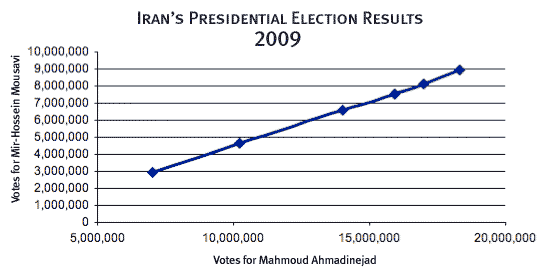
Have the votes for president been properly counted in Florida ?. On the surface, that's a question of simple math. But beneath the number crunching, Republicans and Democrats are waging a war of disguised biases. When data don't turn out the way your theory predicts, should you question the theory or the data ?. When a new vote tally contradicts an old one, should you distrust the first count or the second ?. When one kind of recount is more evenhanded but another is more comprehensive, which is better ?. These dilemmas form the hidden crux of the debate over whether to recount Florida's ballots by hand, as Democrats prefer, or to rely on a machine recount, as Republicans prefer. The two parties aren't being candid about these questions. And math won't answer them.

Guilt by Calculation

This kind of statistical gumshoeing has a long history. In 1936, for example, English biologist and statistician R. A. Fisher went gunning for Gregor Mendel, whose experimental results Fisher believed had been tweaked to be more favorable to Mendel's ideas. "Fictitious data can seldom survive a careful scrutiny," Fisher wrote, "and, since most men underestimate the frequency of large deviations arising by chance, such data may be expected generally to agree more closely with expectation than genuine data would." In other words, it was precisely the beautiful agreement of experiment with theory that exposed Mendel's thumb on the scale. Only once in 15,000 times, Fisher computed, could one expect such strong conformity. ( The controversy over Mendel's research practices continues to this day, with notable scientists lining up on both men's sides ).

Tuesday, June 2, 2009

Dambisa Moyo

Dambisa Moyo was born and raised in Zambia, Southern Africa. She completed a PhD in Economics at Oxford University and holds a Masters from Harvard University. She completed a Bachelors degree in Chemistry and MBA in Finance at the American University in Washington D.C...

...This book ( How the West Was Lost, scheduled for publication with Penguin and Farrar, Straus & Giroux in 2010 ) examines the policy errors made in the US and other Western economies which culminated in the 2008 financial crisis. And discusses why financial and economic experts missed the signs of the credit crunch. It also explores the policy decisions that have placed the emerging world- China, Russia and the Middle East, in pole position to become the dominant economic players in the 21st century.

Monday, May 4, 2009

Palabras del Presidente de la República de Costa Rica Óscar Arias en la Cumbre de las Américas ( 18 de abril del 2009 )

Trinidad y Tobago: 18 de abril del 2009

Tengo la impresión de que cada vez que los países caribeños y latinoamericanos se reúnen con el presidente de los Estados Unidos de América, es para pedirle cosas o para reclamarle cosas. Casi siempre, es para culpar a Estados Unidos de nuestros males pasados, presentes y futuros. No creo que eso sea del todo justo.

No podemos olvidar que América Latina tuvo universidades antes de que Estados Unidos creara Harvard y William & Mary, que son las primeras universidades de ese país. No podemos olvidar que en este continente, como en el mundo entero, por lo menos hasta 1750 todos los americanos eran más o menos iguales: todos eran pobres.

Cuando aparece la Revolución Industrial en Inglaterra, otros países se montan en ese vagón: Alemania, Francia, Estados Unidos, Canadá, Australia, Nueva Zelanda… y así la Revolución Industrial pasó por América Latina como un cometa, y no nos dimos cuenta. Ciertamente perdimos la oportunidad.

También hay una diferencia muy grande. Leyendo la historia de América Latina, comparada con la historia de Estados Unidos, uno comprende que Latinoamérica no tuvo un John Winthrop español, ni portugués, que viniera con la Biblia en su mano dispuesto a construir una Ciudad sobre una Colina, una ciudad que brillara, como fue la pretensión de los peregrinos que llegaron a Estados Unidos.

Hace 50 años, México era más rico que Portugal. En 1950, un país como Brasil tenía un ingreso per cápita más elevado que el de Corea del Sur. Hace 60 años, Honduras tenía más riqueza per cápita que Singapur, y hoy Singapur –en cuestión de 35 ó 40 años– es un país con $40.000 de ingreso anual por habitante. Bueno, algo hicimos mal los latinoamericanos.

¿ Qué hicimos mal ?. No puedo enumerar todas las cosas que hemos hecho mal. Para comenzar, tenemos una escolaridad de 7 años. Esa es la escolaridad promedio de América Latina y no es el caso de la mayoría de los países asiáticos. Ciertamente no es el caso de países como Estados Unidos y Canadá, con la mejor educación del mundo, similar a la de los europeos. De cada 10 estudiantes que ingresan a la secundaria en América Latina, en algunos países solo uno termina esa secundaria. Hay países que tienen una mortalidad infantil de 50 niños por cada mil, cuando el promedio en los países asiáticos más avanzados es de 8, 9 ó 10.

Nosotros tenemos países donde la carga tributaria es del 12% del producto interno bruto, y no es responsabilidad de nadie, excepto la nuestra, que no le cobremos dinero a la gente más rica de nuestros países. Nadie tiene la culpa de eso, excepto nosotros mismos. En 1950, cada ciudadano norteamericano era cuatro veces más rico que un ciudadano latinoamericano. Hoy en día, un ciudadano norteamericano es 10, 15 ó 20 veces más rico que un latinoamericano. Eso no es culpa de Estados Unidos, es culpa nuestra.

En mi intervención de esta mañana, me referí a un hecho que para mí es grotesco, y que lo único que demuestra es que el sistema de valores del siglo XX, que parece ser el que estamos poniendo en práctica también en el siglo XXI, es un sistema de valores equivocado. Porque no puede ser que el mundo rico dedique 100.000 millones de dólares para aliviar la pobreza del 80% de la población del mundo –en un planeta que tiene 2.500 millones de seres humanos con un ingreso de $2 por día– y que gaste 13 veces más ( $1.300.000.000.000 ) en armas y soldados.

Como lo dije esta mañana, no puede ser que América Latina se gaste $50.000 millones en armas y soldados. Yo me pregunto: ¿ Quién es el enemigo nuestro ?. El enemigo nuestro, presidente Correa, de esa desigualdad que usted apunta con mucha razón, es la falta de educación; es el analfabetismo; es que no gastamos en la salud de nuestro pueblo; que no creamos la infraestructura necesaria, los caminos, las carreteras, los puertos, los aeropuertos; que no estamos dedicando los recursos necesarios para detener la degradación del medio ambiente; es la desigualdad que tenemos, que realmente nos avergüenza; es producto, entre muchas cosas, por supuesto, de que no estamos educando a nuestros hijos y a nuestras hijas.

Uno va a una universidad latinoamericana y todavía parece que estamos en los sesenta, setenta u ochenta.

Parece que se nos olvidó que el 9 de noviembre de 1989 pasó algo muy importante, al caer el Muro de Berlín, y que el mundo cambió. Tenemos que aceptar que este es un mundo distinto, y en eso francamente pienso que todos los académicos, que toda la gente de pensamiento, que todos los economistas, que todos los historiadores, casi que coinciden en que el siglo XXI es el siglo de los asiáticos, no de los latinoamericanos. Y yo, lamentablemente, coincido con ellos. Porque mientras nosotros seguimos discutiendo sobre ideologías, seguimos discutiendo sobre todos los ismos ¿ cuál es el mejor ? capitalismo, socialismo, comunismo, liberalismo, neoliberalismo, socialcristianismo...), los asiáticos encontraron un “ismo” muy realista para el siglo XXI y el final del siglo XX, que es el pragmatismo.

Para solo citar un ejemplo, recordemos que cuando Deng Xiaoping visitó Singapur y Corea del Sur, después de haberse dado cuenta de que sus propios vecinos se estaban enriqueciendo de una manera muy acelerada, regresó a Pekín y dijo a los viejos camaradas maoístas que lo habían acompañado en la Larga Marcha: Bueno, la verdad, queridos camaradas, es que mí no me importa si el gato es blanco o negro, lo único que me interesa es que cace ratones. Y si hubiera estado vivo Mao, se hubiera muerto de nuevo cuando dijo que “ la verdad es que enriquecerse es glorioso ”. Y mientras los chinos hacen esto, y desde el 79 a hoy crecen a un 11%, 12% o 13%, y han sacado a 300 millones de habitantes de la pobreza, nosotros seguimos discutiendo sobre ideologías que tuvimos que haber enterrado hace mucho tiempo atrás.

La buena noticia es que esto lo logró Deng Xioping cuando tenía 74 años. Viendo alrededor, queridos Presidentes, no veo a nadie que esté cerca de los 74 años. Por eso solo les pido que no esperemos a cumplirlos para hacer los cambios que tenemos que hacer.

Muchas gracias.

Thursday, April 23, 2009

William F. Loomis: Life as It Is ( book )

This concise, accessible book considers from a biological perspective the controversial issues of our day: Abortion, euthanasia, engineered evolution, cooperativity, and the future of sustainable life on this planet. Exploring in fascinating detail the processes by which cells come into being and multiply, Loomis clearly and simply explains the latest in complex biological research. He reviews recent insights into molecular and human evolution, the role of DNA sequences in determining traits, and the biological basis for consciousness, all of which, he argues, need to be considered when making life-and-death decisions and wrestling with questions about the limits to intervention.

Section of Cell and Developmental Biology, UCSD

Thursday, April 16, 2009

Females get along fine without males - in the world of tropical ants

The Mycocepurus smithii ant is the first known to be a male-free species.

Experts have discovered a South American species that is exclusively female and reproduces asexually by cloning the queen. Reproduction without sex is fairly common in the ant world, but the Mycocepurus smithii is the first known to be a male-free species. The phenomenon takes the stress out of finding a mate and may help keep the peace in colonies, the scientists believe. The findings run counter to scientific theories that say asexuality is an evolutionary disadvantage because it eliminates mutations and generates genetic diversity more slowly than sexual reproduction.
One possible advantage of asexual reproduction is that it avoids the need to find a mate and the efforts associated with mating, according to the researchers.

Wednesday, April 8, 2009

Club P.A.N.

In October 2007, a Workshop was hosted by Cristina Gomes, Chloe Cipoletta, Dr. Herbinger, Mr. Guilahoux and Mr. Ouattara in Abidjan, Ivory Coast, where the teachers from the Club P.A.N. schools were introduced to the project. To see a small video please visit the 2007 workshop section.

Cristina Gomes: Chimps compile Nixon-style 'enemies list'

Chimpanzees have at least one thing in common with the late US president Richard Nixon: tracking those who do them favours and putting those who don't come up to scratch on an "enemies list". Nearly 3000 hours of observations of wild chimpanzees show that they keep tabs on which of the troop has groomed them the most - returning the favour to frequent groomers, while freezing out the selfish ones. In a way, grooming works like currency in chimpanzees, says Cristina Gomes, a behavioural ecologist at the Max Planck Institute for Evolutionary Anthropology in Leipzig, Germany. "If you don't have a set price, then you're susceptible to being cheated and cooperation would probably break down."

Friday, March 20, 2009

The human brain is on the edge of chaos

Cambridge-based researchers provide new evidence that the human brain lives "on the edge of chaos", at a critical transition point between randomness and order. The study, published March 20 in the open-access journal PLoS Computational Biology, provides experimental data on an idea previously fraught with theoretical speculation.

Self-organized criticality (where systems spontaneously organize themselves to operate at a critical point between order and randomness), can emerge from complex interactions in many different physical systems, including avalanches, forest fires, earthquakes, and heartbeat rhythms.

According to this study, conducted by a team from the University of Cambridge, the Medical Research Council Cognition & Brain Sciences Unit, and the GlaxoSmithKline Clinical Unit Cambridge, the dynamics of human brain networks have something important in common with some superficially very different systems in nature. Computational networks showing these characteristics have also been shown to have optimal memory (data storage) and information-processing capacity. In particular, critical systems are able to respond very rapidly and extensively to minor changes in their inputs.