Showing posts with label arXiv. Show all posts

Tuesday, August 25, 2009

Econophysicist Predicts Date of Chinese Stock Market Collapse

The Shanghai Composite Index was supposed to burst before July 27 but didn't. A few days after that deadline, however, it dropped by 20 percent. Coincidence ?.

Last month, we looked at a prediction that the Shanghai Composite stock market index was about to crash. The forecast was made by a team lead by the econophysicist Didier Sornette at the Swiss Federal Institute of Technology in Zurich, who has made a study of economic bubbles and how they burst. His thinking is that bubbles are the result of some kind of feedback mechanism that creates faster-than-exponential growth. This kind of growth rate is straightforward to measure, and so bubbles should be easy to identify. In July, he and his buddies pointed out that the Shanghai Composite stock market index was following exactly this kind of trend. But they also made an extraordinary prediction. They said that this bubble would burst between July 17 and 27.

Sunday, March 22, 2009

D. V. Shirkov: 60 years of Broken Symmetries in Quantum Physics (From the Bogoliubov Theory of Superfluidity to the Standard Model)

A retrospective historical overview of the phenomenon of spontaneous symmetry breaking (SSB) in quantum theory, the issue that has been implemented in particle physics in the form of the Higgs mechanism. The main items are:
1)The Bogoliubov's microscopical theory of superfluidity (1946)
2)The BCS-Bogoliubov theory of superconductivity (1957)
3)Superconductivity as a superfluidity of Cooper pairs (Bogoliubov - 1958)
4)Transfer of the SSB into the QFT models (early 60s)
5)The Higgs model triumph in the electro-weak theory (early 80s)
The role of the Higgs mechanism and its status in the current Standard Model is also touched upon.
.pdf arXiv preprint

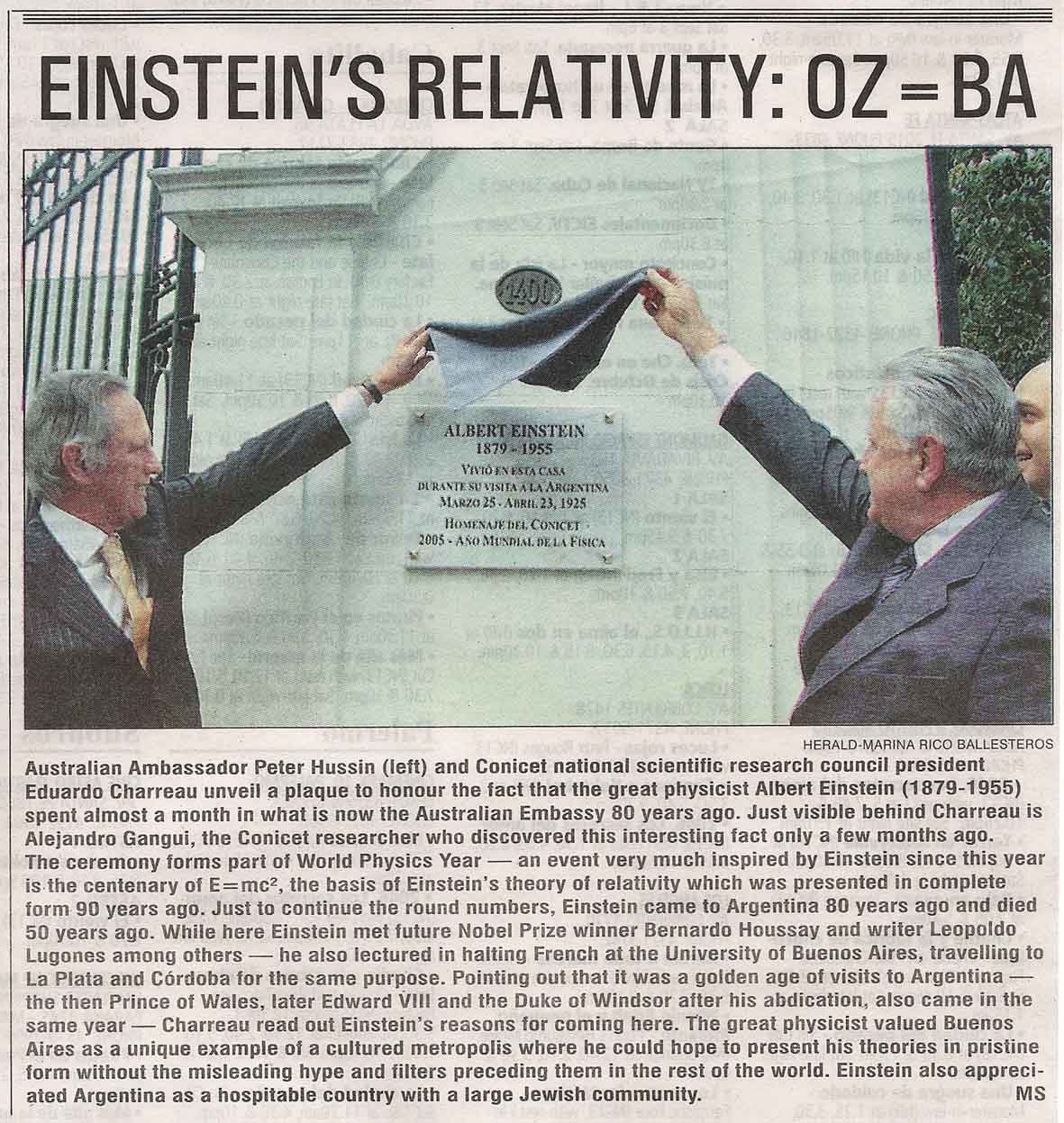
Einstein's unpublished opening lecture for his course on relativity theory in Argentina, 1925

In 1922 the University of Buenos Aires (UBA) Council approved a motion to send an invitation to Albert Einstein to visit Argentina and give a course of lectures on his theory of relativity. The motion was proposed by Jorge Duclout (1856-1927), who had been educated at the Eidgenossische Technische Hochschule, Zurich (ETH). This proposal was the culmination of a series of initiatives of various Argentine intellectuals interested in the theory of relativity. In a very short time Dr. Mauricio Nirenstein (1877-1935), then the university's administrative secretary, fulfilled all the requirements for the university's invitation to be endorsed and delivered to the sage in Berlin. The visit took place three years later, in March-April 1925. The Argentine press received Einstein with great interest and respect; his early exchanges covered a wide range of topics, including international politics and Jewish matters. Naturally, the journalists were more eager to hear from the eminent pacifist than from the incomprehensible physicist. However, after his initial openness with the press, the situation changed and Einstein restricted his public discourse to topics on theoretical physics, avoiding some controversial political, religious, or philosophical matters that he had freely touched upon in earlier interviews.. [abridged].

Can one see entanglement ?

The human eye can detect optical signals containing only a few photons. We investigate the possibility to demonstrate entanglement with such biological detectors.

While one person could not detect entanglement by simply observing photons, we discuss the possibility for several observers to demonstrate entanglement in a Bell-type experiment, in which standard detectors are replaced by human eyes. Using a toy model for biological detectors that captures their main characteristic, namely a detection threshold, we show that Bell inequalities can be violated, thus demonstrating entanglement. Remarkably, when the response function of the detector is close to a step function, quantum non-locality can be demonstrated without any further assumptions. For smoother response functions, as for the human eye, post-selection is required.

Thursday, January 29, 2009

Quantum dreamin and optical illusions

Quantum consciousness, a phrase that sends most eggheads running for the hills, is currently on a roll. A coupla months back, Efstratios “Moussaka” Manousakis of Florida State University in Tallahassee published a paper suggesting that a certain kinda optical illusion could be explained in quantum terms.

Wednesday, January 28, 2009

How a Surfer Dude Stunned the World of Science With the 'Theory of Everything'

A. Garrett Lisi
A laid-back surfer has just drawn up a new theory of the universe that is blowing the establishment’s socks off. His theory is seen by some as the “Holy Grail of physics”, and is earning rave reviews from distinguished scientists. In fact, his model appears to be the elusive overarching explanation to unite all the particles and forces of the cosmos, which has been the most baffling riddle of modern physics—stumping even Einstein. Read more...

Thursday, January 22, 2009

Carlo Beenakker: Physics of the Domino Effect

The Domino Effect is a classic example of a chain reaction: Toppling the first stone in a row of dominoes will bring down the entire row.
See domino effect video.
For the Quiz, which is broadcast on national television on Christmas Eve, I was asked to do the experiment and explain the outcome. My explanation was oversimplified, but the best I could do for a TV show. Hans van Leeuwen (my colleague) provided a much more rigorous analysis (see link at bottom).

Links: Carlo Beenakker Hans van Leeuwen van Leeuwen arXiv preprint