Showing posts with label personajes. Show all posts

Friday, May 21, 2010

Vitaly Lazarevich Ginzburg

Vitaly Lazarevich Ginzburg, who made important contributions in many fields of theoretical physics, passed away on 8 November 2009 in Moscow; he had suffered for several years from a blood disease.

Sunday, October 25, 2009

Preserving the past for the future; Grant aids archival work at Institute. (Old Einstein pictures)

Princeton Township --The archivist lifted the pearl-gray cover off of an oversized folio of photographs recently found at the The National Medal of Science, Awarded by the President of the United States to Kurt Gödel in 1974, part of the Institute for Advanced Study archive collection, photographed on Friday, October 23, 2009. here. From beneath the protective tissue paper emerged a black and white photograph of the great, leonine face of Albert Einstein.

Tuesday, October 20, 2009

Stephen Wolfram: The Man Who Cracked The Code to Everything ...

..."The climax of the book is the principle of computational equivalence, which may as well be called "Wolfram's law." After hundreds of pages of laying groundwork, presenting case after case of visual examples where simple rules generate counterintuitively complex results, Wolfram concludes that this phenomenon is overwhelmingly commonplace - it's at the base of everything from morphology to traffic jams. Then he goes further, stating that once a system achieves a certain, easily attainable degree of complexity, it's reached the point of maximum complexity, as measured by the computation required to crank out the end result. Everything at that level of complexity - and that means almost everything you can think of, from human thought to rain hitting pavement - is exactly as complex as anything else."...

String theory pioneer succeeds Hawking in Lucasian role

One of the founders of string theory has been elected to replace Stephen Hawking as Cambridge University's Lucasian Professor of Mathematics. Professor Michael Green becomes the 18th holder of the professorship. Prof Green, who currently holds the John Humphrey Plummer Professorship of Theoretical Physics is one of the founders of string theory, generally regarded as the most successful candidate to date to unify quantum theory and general relativity, the two fundamental physical theories of the early twentieth century, and thereby formulate a consistent quantum theory of gravity.

Thursday, October 15, 2009

Richard Dawkins: The world's most famous atheist

His new book, The Greatest Show on Earth: The Evidence for Evolution, arrives in the celebratory year that marks Darwin's 200th birthday and the 150th anniversary of the publication of the On the Origin of the Species.
 
Richard Dawkins home page

Douglas Eadline, Ph.D.: The Return of the Vector Processor

Before I dive into Fermi the GPU, I wanted to take a moment and pay tribute to Enrico Fermi the person — for whom the new GPU was named. For you young whippersnappers out there, Enrico Fermi is one of the giants of physics. He was instrumental in advancing physics on many fronts including quantum theory, nuclear and particle physics, and statistical mechanics ( a favorite subject of mine ). He had a rare combination of talent that allowed him to be both an excellent theorist and experimentalist. His legacy is legendary as he has an element named after him ( Fermium, a synthetic element created in 1952 ), a national lab ( the Fermi National Accelerator Lab ), and a class of particles that bare his name ( fermions ). No lightweight this Fermi fellow.

Friday, August 21, 2009

Formalismo de Keldysh (Keldysh Technique)

This technique provides the correct evaluation of the quantum mechanical average of an observable. It means that there is not any assumption about the final system state whenever we perform the above mentioned average. As a consequence, it is a suitable tool to study small systems in contact with macroscopic systems which are in "different" thermodynamic equilibrium states.

See the original Keldysh's papers:
  • L. V. Keldysh, ZhEFT 47, 1515 (1964)
  • L. V. Keldysh, Soviet Physics JEPT 20, 1018 (1965)

Wednesday, July 29, 2009

Geologist Ian Plimer: Global warming is the new religion of First World urban elites

So global warming, says Plimer, is something humans should welcome and embrace as a harbinger of good times to come.

Ian Plimer has outraged the ayatollahs of purist environmentalism, the Torquemadas of the doctrine of global warming, and he seems to relish the damnation they heap on him. Plimer is a geologist, professor of mining geology at Adelaide University, and he may well be Australia's best-known and most notorious academic. Plimer, you see, is an unremitting critic of "anthropogenic global warming" -- man-made climate change to you and me -- and the current environmental orthodoxy that if we change our polluting ways, global warming can be reversed. It is, of course, not new to have a highly qualified scientist saying that global warming is an entirely natural phenomenon with many precedents in history. Many have made the argument, too, that it is rubbish to contend human behaviour is causing the current climate change. And it has often been well argued that it is totally ridiculous to suppose that changes in human behaviour -- cleaning up our act through expensive slight-of-hand taxation tricks -- can reverse the trend.

Sunday, July 12, 2009

A Brief Outline of the Development of the Theory of Relativity By Prof. A. Einstein

There is something attractive in presenting the evolution of a sequence of ideas in as brief a form as possible, and yet with a completeness sufficient to preserve throughout the continuity of development. We shall endeavour to do this for the Theory of Relativity, and to show that the whole ascent is composed of small, almost self-evident steps of thought. The entire development starts off from, and is dominated by, the idea of Faraday and Maxwell, according to which all physical processes involve a continuity of action (as opposed to action at a distance), or, in the language of mathematics, they are expressed by partial differential equations. Maxwell succeeded in doing this for electro-magnetic processes in bodies at rest by means of the conception of the magnetic effect of the vacuum-displacement-current, together with the postulate of the identity of the nature of electro-dynamic fields produced by induction, and the electro-static field.

Thursday, July 2, 2009

Mancur Olson (La Lógica de la Acción Colectiva, etc...)

Mancur Olson ( 1932 - 19 de febrero de 1998 ) fue un destacado economista y sociólogo estadounidense que, en el momento de su muerte, trabajaba en el College Park de la Universidad de Maryland. Realizó importantes contribuciones a los estudios de economía política en temas como las funciones de la propiedad privada, los impuestos, los bienes públicos, las acciones colectivas y el desarrollo económico. Olson destacó la base lógica de la participación en los grupos de presión. Las teorías políticas predominantes en su época atribuían un papel primordial a la pertenencia y la participación en los grupos de presión. Unas apelaban a la existencia de un instinto humano por la creación de grupos, otros atribuían el proceso de modernización a la formación de grupos basados en el parentesco. Olson ofreció una explicación radicalmente diferente del fundamento lógico de la acción colectiva organizada. En su primer libro La lógica de la acción colectiva: bienes públicos y la teoría de grupos, propuso que "sólo un incentivo individual y selectivo estimularía a una persona racional de un grupo latente a actuar con un espíritu grupal"; es decir, que sólo un beneficio reservado estrictamente a miembros de un grupo motivaría a alguien a unirse y contribuir al grupo. Esto significa que los individuos actuarán colectivamente para proporcionar bienes privados, no para proporcionar bienes públicos.

Thursday, June 25, 2009

Steven Weinberg: From BCS to the LHC

Steven Weinberg reflects on spontaneous symmetry breaking, and the connection between condensed-matter physics and particle physics, in a talk at the University of Illinois in Urbana, celebrating the 50th anniversary of the BCS theory of superconductivity. It was a little odd for me, a physicist whose work has been mainly on the theory of elementary particles, to be invited to speak at a meeting of condensed-matter physicists celebrating a great achievement in their field. It is not only that there is a difference in the subjects that we explore. There are deep differences in our aims, in the kinds of satisfaction that we hope to get from our work. Condensed-matter physicists are often motivated to deal with phenomena because the phenomena themselves are intrinsically so interesting. Who would not be fascinated by weird things, such as superconductivity, superfluidity, or the quantum Hall effect? On the other hand, I don't think that elementary-particle physicists are generally very excited by the phenomena they study. The particles themselves are practically featureless, every electron looking tediously just like every other electron.

Tuesday, June 2, 2009

Dambisa Moyo

Dambisa Moyo was born and raised in Zambia, Southern Africa. She completed a PhD in Economics at Oxford University and holds a Masters from Harvard University. She completed a Bachelors degree in Chemistry and MBA in Finance at the American University in Washington D.C...

...This book ( How the West Was Lost, scheduled for publication with Penguin and Farrar, Straus & Giroux in 2010 ) examines the policy errors made in the US and other Western economies which culminated in the 2008 financial crisis. And discusses why financial and economic experts missed the signs of the credit crunch. It also explores the policy decisions that have placed the emerging world- China, Russia and the Middle East, in pole position to become the dominant economic players in the 21st century.

Monday, May 4, 2009

Palabras del Presidente de la República de Costa Rica Óscar Arias en la Cumbre de las Américas ( 18 de abril del 2009 )

Trinidad y Tobago: 18 de abril del 2009

Tengo la impresión de que cada vez que los países caribeños y latinoamericanos se reúnen con el presidente de los Estados Unidos de América, es para pedirle cosas o para reclamarle cosas. Casi siempre, es para culpar a Estados Unidos de nuestros males pasados, presentes y futuros. No creo que eso sea del todo justo.

No podemos olvidar que América Latina tuvo universidades antes de que Estados Unidos creara Harvard y William & Mary, que son las primeras universidades de ese país. No podemos olvidar que en este continente, como en el mundo entero, por lo menos hasta 1750 todos los americanos eran más o menos iguales: todos eran pobres.

Cuando aparece la Revolución Industrial en Inglaterra, otros países se montan en ese vagón: Alemania, Francia, Estados Unidos, Canadá, Australia, Nueva Zelanda… y así la Revolución Industrial pasó por América Latina como un cometa, y no nos dimos cuenta. Ciertamente perdimos la oportunidad.

También hay una diferencia muy grande. Leyendo la historia de América Latina, comparada con la historia de Estados Unidos, uno comprende que Latinoamérica no tuvo un John Winthrop español, ni portugués, que viniera con la Biblia en su mano dispuesto a construir una Ciudad sobre una Colina, una ciudad que brillara, como fue la pretensión de los peregrinos que llegaron a Estados Unidos.

Hace 50 años, México era más rico que Portugal. En 1950, un país como Brasil tenía un ingreso per cápita más elevado que el de Corea del Sur. Hace 60 años, Honduras tenía más riqueza per cápita que Singapur, y hoy Singapur –en cuestión de 35 ó 40 años– es un país con $40.000 de ingreso anual por habitante. Bueno, algo hicimos mal los latinoamericanos.

¿ Qué hicimos mal ?. No puedo enumerar todas las cosas que hemos hecho mal. Para comenzar, tenemos una escolaridad de 7 años. Esa es la escolaridad promedio de América Latina y no es el caso de la mayoría de los países asiáticos. Ciertamente no es el caso de países como Estados Unidos y Canadá, con la mejor educación del mundo, similar a la de los europeos. De cada 10 estudiantes que ingresan a la secundaria en América Latina, en algunos países solo uno termina esa secundaria. Hay países que tienen una mortalidad infantil de 50 niños por cada mil, cuando el promedio en los países asiáticos más avanzados es de 8, 9 ó 10.

Nosotros tenemos países donde la carga tributaria es del 12% del producto interno bruto, y no es responsabilidad de nadie, excepto la nuestra, que no le cobremos dinero a la gente más rica de nuestros países. Nadie tiene la culpa de eso, excepto nosotros mismos. En 1950, cada ciudadano norteamericano era cuatro veces más rico que un ciudadano latinoamericano. Hoy en día, un ciudadano norteamericano es 10, 15 ó 20 veces más rico que un latinoamericano. Eso no es culpa de Estados Unidos, es culpa nuestra.

En mi intervención de esta mañana, me referí a un hecho que para mí es grotesco, y que lo único que demuestra es que el sistema de valores del siglo XX, que parece ser el que estamos poniendo en práctica también en el siglo XXI, es un sistema de valores equivocado. Porque no puede ser que el mundo rico dedique 100.000 millones de dólares para aliviar la pobreza del 80% de la población del mundo –en un planeta que tiene 2.500 millones de seres humanos con un ingreso de $2 por día– y que gaste 13 veces más ( $1.300.000.000.000 ) en armas y soldados.

Como lo dije esta mañana, no puede ser que América Latina se gaste $50.000 millones en armas y soldados. Yo me pregunto: ¿ Quién es el enemigo nuestro ?. El enemigo nuestro, presidente Correa, de esa desigualdad que usted apunta con mucha razón, es la falta de educación; es el analfabetismo; es que no gastamos en la salud de nuestro pueblo; que no creamos la infraestructura necesaria, los caminos, las carreteras, los puertos, los aeropuertos; que no estamos dedicando los recursos necesarios para detener la degradación del medio ambiente; es la desigualdad que tenemos, que realmente nos avergüenza; es producto, entre muchas cosas, por supuesto, de que no estamos educando a nuestros hijos y a nuestras hijas.

Uno va a una universidad latinoamericana y todavía parece que estamos en los sesenta, setenta u ochenta.

Parece que se nos olvidó que el 9 de noviembre de 1989 pasó algo muy importante, al caer el Muro de Berlín, y que el mundo cambió. Tenemos que aceptar que este es un mundo distinto, y en eso francamente pienso que todos los académicos, que toda la gente de pensamiento, que todos los economistas, que todos los historiadores, casi que coinciden en que el siglo XXI es el siglo de los asiáticos, no de los latinoamericanos. Y yo, lamentablemente, coincido con ellos. Porque mientras nosotros seguimos discutiendo sobre ideologías, seguimos discutiendo sobre todos los ismos ¿ cuál es el mejor ? capitalismo, socialismo, comunismo, liberalismo, neoliberalismo, socialcristianismo...), los asiáticos encontraron un “ismo” muy realista para el siglo XXI y el final del siglo XX, que es el pragmatismo.

Para solo citar un ejemplo, recordemos que cuando Deng Xiaoping visitó Singapur y Corea del Sur, después de haberse dado cuenta de que sus propios vecinos se estaban enriqueciendo de una manera muy acelerada, regresó a Pekín y dijo a los viejos camaradas maoístas que lo habían acompañado en la Larga Marcha: Bueno, la verdad, queridos camaradas, es que mí no me importa si el gato es blanco o negro, lo único que me interesa es que cace ratones. Y si hubiera estado vivo Mao, se hubiera muerto de nuevo cuando dijo que “ la verdad es que enriquecerse es glorioso ”. Y mientras los chinos hacen esto, y desde el 79 a hoy crecen a un 11%, 12% o 13%, y han sacado a 300 millones de habitantes de la pobreza, nosotros seguimos discutiendo sobre ideologías que tuvimos que haber enterrado hace mucho tiempo atrás.

La buena noticia es que esto lo logró Deng Xioping cuando tenía 74 años. Viendo alrededor, queridos Presidentes, no veo a nadie que esté cerca de los 74 años. Por eso solo les pido que no esperemos a cumplirlos para hacer los cambios que tenemos que hacer.

Muchas gracias.

Tuesday, April 28, 2009

The TRUTH about all those dodgy health claims, by one of Britain's top researchers

Now, Professor Regan is applying her trademark scientific training to examine the health credentials of an even wider range of products for her latest BBC2 series. And not only has she discovered some bestsellers have little evidence backing them up, she believes many companies are, in fact, touting spurious claims. Here, she shares a few of her intriguing findings...

To prove this point, I developed my own diet pill and asked 17 overweight people to try it for a month, alongside a balanced diet and a sensible exercise plan. More than 70 per cent of the volunteers lost weight and believed the tablets had worked. Unbeknown to them, though, the tablets were simply sugar, a placebo - which shows the power of mind over matter. Yet I could easily use my results to launch an impressive marketing campaign, - as many companies do.

Thursday, April 23, 2009

William F. Loomis: Life as It Is ( book )

This concise, accessible book considers from a biological perspective the controversial issues of our day: Abortion, euthanasia, engineered evolution, cooperativity, and the future of sustainable life on this planet. Exploring in fascinating detail the processes by which cells come into being and multiply, Loomis clearly and simply explains the latest in complex biological research. He reviews recent insights into molecular and human evolution, the role of DNA sequences in determining traits, and the biological basis for consciousness, all of which, he argues, need to be considered when making life-and-death decisions and wrestling with questions about the limits to intervention.

Section of Cell and Developmental Biology, UCSD
Wednesday, April 22, 2009

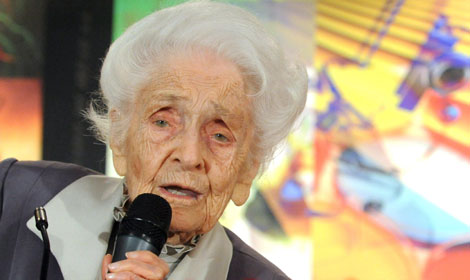
La premio Nobel italiana nació en Turín el 22 de abril de 1909

A principios de los 50, junto con el joven bioquímico norteamericano Stanley Cohen, Levi-Montalcini da un vuelco a su carrera: descubre e identifica el NGF, el Factor de crecimiento nervioso. Años después, en 1986, estas investigaciones valdrán a los dos el Premio Nobel de Medicina. Es una etapa particularmente feliz de su vida, llena de satisfacción profesional: la misma que, de haber seguido la

Saturday, April 18, 2009

Nana Cadavieco

http://www.enoriente.com/noticias-magazine-105/arte-y-espectlos-magazine-112/14571-karmapa-pablo-dagnino-y-nana-cadavieco-recordaran-a-soda-stereo-en-concierto:

"...Nana Cadavieco es cantautora y para finales de abril 2009 lanzará su primer disco titulado “Exposé”, producido por Erik Aldrey (Le Picó, Londres/Caracas) en Sala de Máquinas y masterizado en 360º Studios, Londres, por Richard Beetham. “Exposé” cuenta con la participación de talentosos músicos venezolanos como Wincho Schäfer (Sentimiento Muerto), Rafael Cadavieco (Zapato 3) y Ezequiel S. Valencia (Cabezon Key - Tribop). También hacen apariciones especiales Gabriel Figueira, Armando Alvarez y Abiram Brizuela, de Gaêlica..."

Wednesday, April 15, 2009

ARI FLEISCHER: Everyone Should Pay Income Taxes

In addition to exempting almost 50% of the country from income taxes, today nearly every other social cause is given a loophole -- or a preference -- in the tax code. Want to buy a hybrid vehicle? You get a tax break. Do you own a solar water heater? You get a credit. Want to give to charity? You get a deduction. Own a house? There's another tax deduction for you. How about college savings, certain medical costs, and retirement savings? Yes, yes, and of course yes. Did you move, pay alimony, or "provide housing to a Midwestern displaced individual"? More deductions, credits and exemptions there too, if you qualify.

A very small number of taxpayers -- the 10% of the country that makes more than $92,400 a year -- pay 72.4% of the nation's income taxes.

Wednesday, April 8, 2009

Club P.A.N.

In October 2007, a Workshop was hosted by Cristina Gomes, Chloe Cipoletta, Dr. Herbinger, Mr. Guilahoux and Mr. Ouattara in Abidjan, Ivory Coast, where the teachers from the Club P.A.N. schools were introduced to the project. To see a small video please visit the 2007 workshop section.

Cristina Gomes: Chimps compile Nixon-style 'enemies list'

Chimpanzees have at least one thing in common with the late US president Richard Nixon: tracking those who do them favours and putting those who don't come up to scratch on an "enemies list". Nearly 3000 hours of observations of wild chimpanzees show that they keep tabs on which of the troop has groomed them the most - returning the favour to frequent groomers, while freezing out the selfish ones. In a way, grooming works like currency in chimpanzees, says Cristina Gomes, a behavioural ecologist at the Max Planck Institute for Evolutionary Anthropology in Leipzig, Germany. "If you don't have a set price, then you're susceptible to being cheated and cooperation would probably break down."