Wednesday, July 29, 2009

Organic food is no healthier, study finds

Organic food has no nutritional or health benefits over ordinary food, according to a major study published Wednesday. Researchers from the London School of Hygiene & Tropical Medicine said consumers were paying higher prices for organic food because of its perceived health benefits, creating a global organic market worth an estimated $48 billion in 2007.

Geologist Ian Plimer: Global warming is the new religion of First World urban elites

So global warming, says Plimer, is something humans should welcome and embrace as a harbinger of good times to come.

Ian Plimer has outraged the ayatollahs of purist environmentalism, the Torquemadas of the doctrine of global warming, and he seems to relish the damnation they heap on him. Plimer is a geologist, professor of mining geology at Adelaide University, and he may well be Australia's best-known and most notorious academic. Plimer, you see, is an unremitting critic of "anthropogenic global warming" -- man-made climate change to you and me -- and the current environmental orthodoxy that if we change our polluting ways, global warming can be reversed. It is, of course, not new to have a highly qualified scientist saying that global warming is an entirely natural phenomenon with many precedents in history. Many have made the argument, too, that it is rubbish to contend human behaviour is causing the current climate change. And it has often been well argued that it is totally ridiculous to suppose that changes in human behaviour -- cleaning up our act through expensive slight-of-hand taxation tricks -- can reverse the trend.

Friday, July 17, 2009

World's tiniest lamp spans quantum and classical physics

The smallest ever incandescent lamp, made using a single carbon nanotube, has been created by physicists in the US. At 1.4 micrometres long and just 13 nanometres wide, the filament is invisible to the naked eye until it is switched on. Chris Regan's team at the University of California, Los Angeles attached a palladium and gold electrode to each end of the carbon nanotube, which spans a tiny hole in a silicon chip and is held in a vacuum. When electricity runs along the nanotube it heats up and begins to glow, releasing millions of photons every second, of which a few thousand reach the eye. "That makes the light relatively easy to see," says Regan. "Your eye is nearly single-photon sensitive." But it would make a poor reading lamp, he joke

Memristor minds: The future of artificial intelligence

In 1971, Leon Chua had that feeling. A young electronics engineer with a penchant for mathematics at the University of California, Berkeley, he was fascinated by the fact that electronics had no rigorous mathematical foundation. So like any diligent scientist, he set about trying to derive one. And he found something missing: a fourth basic circuit element besides the standard trio of resistor, capacitor and inductor. Chua dubbed it the "memristor". The only problem was that as far as Chua or anyone else could see, memristors did not actually exist.

Thursday, July 16, 2009

Humor In The Workplace

This is a sources sought notice and not a request for quotations. The purpose of this announcement is to seek qualified contractors with the capability to provide presentations for The Department of Treasury, Bureau of the Public Debt (BPD), Management Meeting with experience in meeting the objectives as described herein.

The Contractor shall conduct two, 3-hour, Humor in the Workplace programs...

Sunday, July 12, 2009

A Brief Outline of the Development of the Theory of Relativity By Prof. A. Einstein

There is something attractive in presenting the evolution of a sequence of ideas in as brief a form as possible, and yet with a completeness sufficient to preserve throughout the continuity of development. We shall endeavour to do this for the Theory of Relativity, and to show that the whole ascent is composed of small, almost self-evident steps of thought. The entire development starts off from, and is dominated by, the idea of Faraday and Maxwell, according to which all physical processes involve a continuity of action (as opposed to action at a distance), or, in the language of mathematics, they are expressed by partial differential equations. Maxwell succeeded in doing this for electro-magnetic processes in bodies at rest by means of the conception of the magnetic effect of the vacuum-displacement-current, together with the postulate of the identity of the nature of electro-dynamic fields produced by induction, and the electro-static field.

Wednesday, July 8, 2009

Electrons in graphene: an interacting fluid par excellence

Ever since it was shown that graphene—a single layer of carbon atoms—could be isolated from graphite, it has occupied a center stage of condensed matter physics. The popularity of graphene is rooted in the unusual nature of its low-energy excitations: near the Fermi level, the electron energies scale linearly with their momenta. This means that the electrons can be described as massless fermions, though with a velocity of about 300 times less than the velocity of light. The linear dispersion relation also implies a vanishing density of single-particle states at the Fermi level, which should make the effects of the Coulomb interaction between electrons weak.

Tuesday, July 7, 2009

40+ Excellent Freefonts For Professional Design

The importance of typography in design can’t be overestimated. The accuracy, precision and balance of geometric forms can give letters the elegance and sharpness they deserve. Besides, elegant fonts can help to convey the message in a more convenient way. In fact, while there are many excellent professional fonts (we’ve presented some of them in our article 80 Beautiful Typefaces For Professional Design) there are literally thousands of free low-quality fonts which you would never use for professional designs.

HTML 5 Won’t Be Ready Until 2022. Yes, 2022

If you’re a web developer looking forward to the new tools in HTML 5, the next generation of the language that powers the web, we have some bad news for you — you’re going to waiting a while. Ian Hickson, the editor of the HTML 5 specification, recently outlined the time table for HTML 5 and, even assuming browser manufacturers embrace HTML 5 when it reaches the final draft stage, that puts HTML 5’s widespread adoption at 2012. Worse, the final proposed recommendation won’t be released until 2022.

Thursday, July 2, 2009

Mark Gimein -> Swan Song: Why Nassim Taleb is Still Wrong

While for just about everyone involved in the markets the last two years of financial history have been a massacre, they have been a long victory lap for Nassim Nicholas Taleb. Taleb is the author of The Black Swan, the book about, as the subtitle puts it, "The Impact of the Highly Improbable." It came out in 2007, just before everything that seemed highly improbable became painfully actual. As everyone else's fortunes have shrunk, Taleb's have risen. Not only have his books made him the public face of the New Catastrophism, but his insights have turned out to be extremely profitable: The Wall Street Journal reports that Universa, a hedge fund for which Taleb serves as guru and adviser, gained more than 100 percent last year and now holds $6 billion.

Ant mega-colony takes over world

A single mega-colony of ants has colonised much of the world, scientists have discovered. Argentine ants living in vast numbers across Europe, the US and Japan belong to the same inter-related colony, and will refuse to fight one another. The colony may be the largest of its type ever known for any insect species, and could rival humans in the scale of its world domination. What's more, people are unwittingly helping the mega-colony stick together. Argentine ants (Linepithema humile) were once native to South America. But people have unintentionally introduced the ants to all continents except Antarctica. These introduced Argentine ants are renowned for forming large colonies, and for becoming a significant pest, attacking native animals and crops.

Mancur Olson (La Lógica de la Acción Colectiva, etc...)

Mancur Olson ( 1932 - 19 de febrero de 1998 ) fue un destacado economista y sociólogo estadounidense que, en el momento de su muerte, trabajaba en el College Park de la Universidad de Maryland. Realizó importantes contribuciones a los estudios de economía política en temas como las funciones de la propiedad privada, los impuestos, los bienes públicos, las acciones colectivas y el desarrollo económico. Olson destacó la base lógica de la participación en los grupos de presión. Las teorías políticas predominantes en su época atribuían un papel primordial a la pertenencia y la participación en los grupos de presión. Unas apelaban a la existencia de un instinto humano por la creación de grupos, otros atribuían el proceso de modernización a la formación de grupos basados en el parentesco. Olson ofreció una explicación radicalmente diferente del fundamento lógico de la acción colectiva organizada. En su primer libro La lógica de la acción colectiva: bienes públicos y la teoría de grupos, propuso que "sólo un incentivo individual y selectivo estimularía a una persona racional de un grupo latente a actuar con un espíritu grupal"; es decir, que sólo un beneficio reservado estrictamente a miembros de un grupo motivaría a alguien a unirse y contribuir al grupo. Esto significa que los individuos actuarán colectivamente para proporcionar bienes privados, no para proporcionar bienes públicos.

Examples of Mathematical Physics

One challenge in a course like this is to maintain the connection with actual applications of the techniques one is covering. Since I was originally taught this material in a set of courses as a mathematics undergraduate, my own take on the material can be rather formal, and I have worked over the years to balance this out. However, as you might guess, my own examples are predominantly drawn from those areas of physics with which I am most familiar - for example, supersymmetry, and the restrictions that holomorphy places on superpotentials, is a nice illustration of the power of complex analysis.

See this useful link.

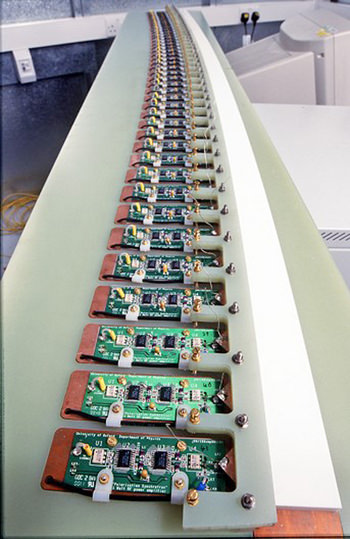
Device Makes Radio Waves Travel Faster Than Light

A scientist has created a gadget that can make radio waves travel faster than light. Einstein predicted that particles and information can't travel faster than the speed of light, but phenomena like radio waves are a different story, said John Singleton, who works at the Los Alamos National Laboratory. The polarization synchrotron combines the waves with a rapidly spinning magnetic field, and the result could explain why pulsars — which are super-dense spinning stars that are a subclass of neutron stars — emit such powerful signals, a phenomenon that has baffled many scientists.

Patrick Cox: The Quantum Leap of Quantum Computing

The electronics and computing industries are getting primed for a massive transformation in the years ahead. Quantum technologies that were only theories in scientific journals just a few years ago are being prototyped in labs now. These new components will change the way we live forever. They will also create transformational profit opportunities.

Tuesday, June 30, 2009

Quantum mechanical evolution towards thermal equilibrium

The circumstances under which a system reaches thermal equilibrium, and how to derive this from basic dynamical laws, has been a major question from the very beginning of thermodynamics and statistical mechanics.

Despite considerable progress, it remains an open problem.

Motivated by this issue, we address the more general question of equilibration. We prove, with virtually full generality, that reaching equilibrium is a universal property of quantum systems: almost any subsystem in interaction with a large enough bath will reach an equilibrium state and remain close to it for almost all times. We also prove several general results about other aspects of thermalization besides equilibration, for example, that the equilibrium state does not depend on the detailed microstate of the bath.

How to Avoid Yourself

Every Sunday morning you go for a walk in the city, heading nowhere in particular, with just one rule to your rambling: You never retrace your steps or cross your own path. If you have already walked along a certain block or passed through an intersection, you refuse to set foot there again.

This recipe for tracing a loopless path through a grid of city streets leads into some surprisingly dark back alleys of mathematics—not to mention byways of physics, chemistry, computer science and biology. Avoiding yourself, it turns out, is a hard problem. The exact analysis of self-avoiding walks has stumped mathematicians for half a century; even counting the walks is a challenge.

My own initiation into the trials of self-avoidance came when I began experimenting with a simple model of the folding of protein molecules, a story I told in an earlier "Computing Science" column (see Hayes 1998). Protein folding is close to the historical roots of the self-avoiding walk, which was first conceived as a tool for understanding the geometry of long-chain polymer molecules. A polymer writhing and wriggling in solution forms a random tangle—random, that is, except that no two atoms can occupy the same position at the same time. This "excluded volume effect" in the polymer is modeled by the walk's insistence on avoiding itself.

Friday, June 26, 2009

Swimming in the Fermi sea

When one “immerses” a particle in a quantum many-body system, for instance an electron in a solid, the particle “swims” shrouded by a cloud of excitations of its new environment. This composite object is called a quasiparticle and possesses the same features as the initial particle, but with modified physical properties ( mass, charge, etc... ).

As with other many-body phenomena, the ab initio calculation of quasiparticle properties is highly challenging, and in most cases it can only be treated approximately. To overcome this challenge, use of the versatility of laser-cooled gases to simulate many-body condensed matter systems has recently been proposed.

Writing in Physical Review Letters, André Schirotzek, Cheng-Hsun Wu, Ariel Sommer, and Martin Zwierlein from MIT in the US present a dramatic demonstration of this scheme by studying experimentally the behavior of an atomic impurity immersed in a Fermi sea of ultracold atoms: A very simple system that constitutes the epitome of quasiparticle physics.

Thursday, June 25, 2009

Steven Weinberg: From BCS to the LHC

Steven Weinberg reflects on spontaneous symmetry breaking, and the connection between condensed-matter physics and particle physics, in a talk at the University of Illinois in Urbana, celebrating the 50th anniversary of the BCS theory of superconductivity. It was a little odd for me, a physicist whose work has been mainly on the theory of elementary particles, to be invited to speak at a meeting of condensed-matter physicists celebrating a great achievement in their field. It is not only that there is a difference in the subjects that we explore. There are deep differences in our aims, in the kinds of satisfaction that we hope to get from our work. Condensed-matter physicists are often motivated to deal with phenomena because the phenomena themselves are intrinsically so interesting. Who would not be fascinated by weird things, such as superconductivity, superfluidity, or the quantum Hall effect? On the other hand, I don't think that elementary-particle physicists are generally very excited by the phenomena they study. The particles themselves are practically featureless, every electron looking tediously just like every other electron.

Tuesday, June 23, 2009

Ayuda de Webmasters

La finalidad de este foro es proporcionar un lugar de encuentro para que los webmasters se ayuden entre ellos y, en ocasiones, nosotros aportemos consejos, clarificaciones y os mantengamos al día de las novedades. Antes de enviar una pregunta os aconsejamos echar un vistazo a estos recursos y si quieres seguirla utiliza su feed: ...